Hajana Technologies Logo
Hajana Technologies
Anthropic Claude SalesforceClaudeforce

What is Claudeforce? Understanding Salesforce and Anthropic’s Hybrid AI Architecture

HT

Hajana Technologies Engineering Team

September 1, 2026
8 min read
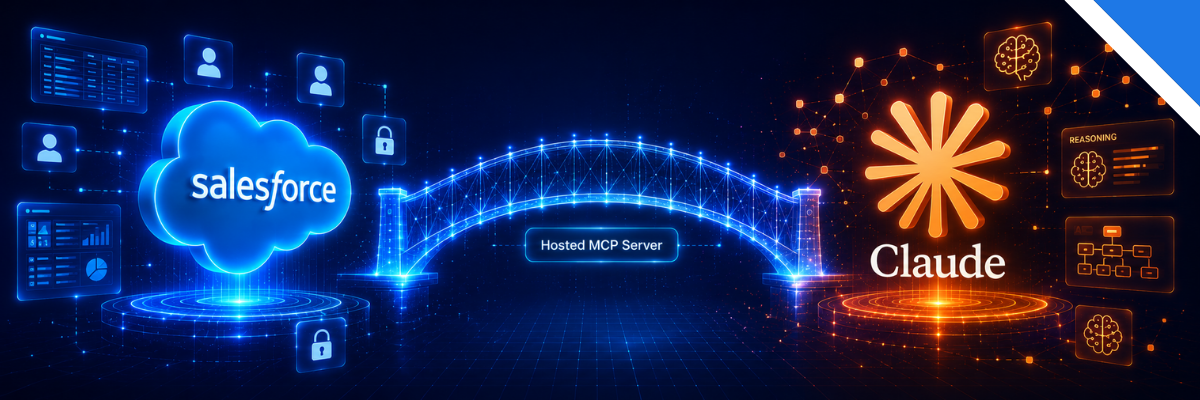
Glowing blue bridge labeled Hosted MCP Server connecting Salesforce CRM and Claude AI logos across a digital landscape
For nearly three decades, enterprise software operated under a single, dominant paradigm: work happens inside graphical user interfaces (GUIs). To update a pipeline, log a customer interaction, or review deal health, employees had to open a browser tab, navigate a series of menus, and manually input data into structured fields.
The expanded partnership between Salesforce and Anthropic - headlined by Claudeforce - signals a fundamental shift in enterprise software design.
Instead of forcing revenue, service, and operations teams to log into traditional software screens, Claudeforce decouples the interface from the system of record. It connects Anthropic’s advanced reasoning models directly to Salesforce enterprise record objects, allowing users to query, reason over, and execute governed actions using natural language - all while keeping core data models, business rules, and sharing permissions intact within Salesforce.
Below is an architectural breakdown of what Claudeforce actually ships, how its underlying integration pipeline operates, and how enterprise technology leaders can prepare for agentic CRM workflows.

What is Claudeforce?

Claudeforce is the umbrella designation for the expanded strategic alliance between Salesforce and Anthropic. It fuses probabilistic intelligence (Claude’s reasoning, planning, and language capabilities) with deterministic systems of record (Salesforce’s business logic, object structures, and permission architecture).

PROBABILISTIC REASONING

Anthropic Claude ModelsIntent Recognition, Dynamic Planning, Natural UI
Model Context Protocol (MCP) / API's

DETERMINISTIC ENTERPRISE

Salesforce Data EngineObjects, Sharing Rules, Validation Logic, Audit Trails

The release spans three primary technical deployment surfaces:

1. Salesforce in Claude (The Managed Plugin)

The flagship consumer capability is a pre-packaged plugin that exposes live Salesforce data directly within the Claude interface. Shipping with 37 pre-built sales skills (such as automated meeting preparation, deal health analysis, and pipeline reconciliation), it allows sellers to execute complex actions across their revenue stack through natural language conversation.

2. Claude in Salesforce (Agentforce Integration)

Claude serves as a core reasoning model within Salesforce’s native agentic platforms. It powers the Atlas Reasoning Engine plan-and-act loops, acts as a default foundation model across Agentforce Vibes and Agentforce Coworker, and remains a selectable model option within Agent Builder.

3. Claude in Slack

Claude acts as the intelligent default engine across Slack workspaces, powering Slackbot and developer tools. This enables contextual conversation inside a Slack channel to trigger governed actions directly within Salesforce without context-switching.

Under the Hood: Headless 360 and Hosted MCP Architecture

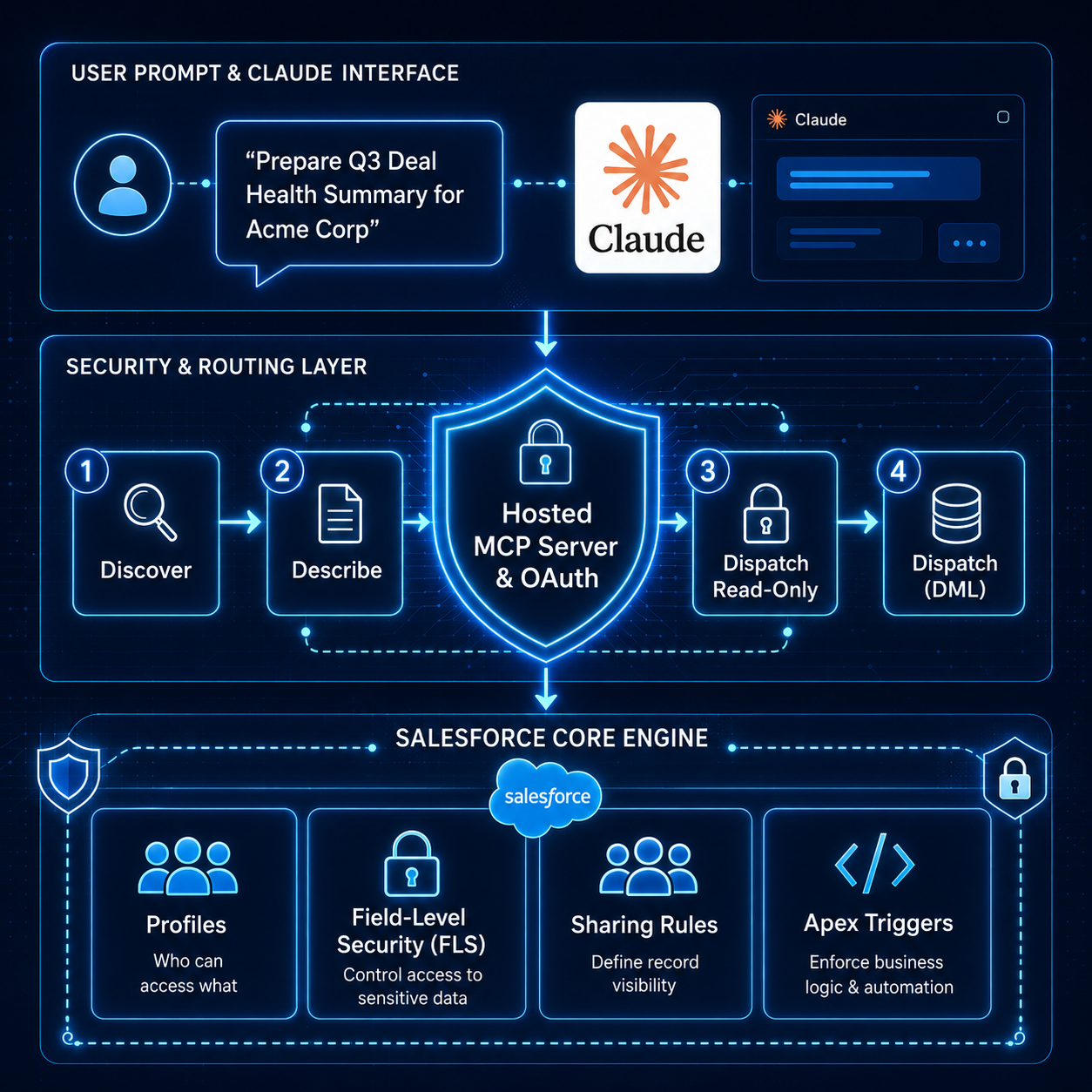
Architecture diagram detailing Claudeforce workflow from User Prompt through Hosted MCP Server and Security Layer down to Salesforce Core Engine
To understand how Claudeforce operates without compromising security, enterprise architects must look past the consumer branding to the underlying infrastructure.
Claudeforce is built upon Salesforce’s Headless 360 initiative - a framework designed to expose platform capabilities as APIs, Model Context Protocol (MCP) tools, and command-line interfaces rather than fixed UI screens.

The Claudeforce Request & Execution Pipeline:

  1. User Prompt & Agent Execution Skill (Anthropic Claude Interface)
    • Per-User OAuth Authorization (mcp_api Scope)
  2. Salesforce Hosted MCP Server
    • discover → Semantic search across registered Salesforce operations.
    • describe → Fetches the technical API payload specification.
    • dispatch_readonly → Safely fetches record data (GET).
    • dispatch → Executes state changes (POST, PUT, PATCH, DELETE).→ Identity Enforcement & Policy Validation
  3. Salesforce Core Org Execution
    • Enforces Profiles, Sharing Rules, Field-Level Security (FLS), Apex Triggers, and Validation Rules.

The 4-Tool MCP Pattern

Rather than exposing thousands of raw Salesforce REST endpoints to the language model - which would overwhelm the model's context window - the Headless 360 Hosted MCP Server uses a disciplined, four-tool discovery loop:
  1. discover (Semantic Search): The model passes the user’s intent to perform a semantic search across registered Salesforce operations, returning a ranked candidate list.
  2. describe (Spec Inspection): The model requests the exact technical specification, required arguments, and payload schema for the chosen operation.
  3. dispatch_readonly (Safe Data Fetching): Executes GET operations to inspect records without altering data state.
  4. dispatch (State Execution): Invokes state-changing actions (POST, PUT, PATCH, DELETE) against Salesforce core objects.
This approach keeps the agent’s tool surface minimal and predictable while scaling to support custom objects and complex enterprise workflows.

Enterprise Security & Governance: The Dual Authentication Model

The primary challenge when connecting AI agents to enterprise CRMs is permission management. Un-gated AI agents operating under broad credentials present significant security and compliance risks.
Claudeforce addresses this through a dual-path security model. Enterprise architects must distinguish between these two integration routes:
Security VectorSalesforce in Claude (Hosted MCP)Claude Tag / Slack Integration

Auth Pattern

Per-User OAuth 2.0 via External Client App

Client Credentials Flow (Integration User)

Identity Context

Executes strictly as the logged-in user

Executes under a centralized Agent System Identity

Permission Bounds

Enforces Object-Level (CRUD), Field-Level Security (FLS), and User Sharing Rules

Scoped strictly via assigned Access Bundles & Scopes

Best-Fit Use Case

Individual seller tasks, account updates, pipeline queries

Team-wide channel interactions, event triggers

The Amazon Bedrock Security Boundary

For organizations operating in regulated sectors (such as Healthcare, Life Sciences, Financial Services, and the Public Sector), Claudeforce routes Claude inference workloads through Amazon Bedrock inside the Salesforce Trust Boundary.
Proprietary enterprise context, customer records, and model inferences remain isolated within the enterprise security boundary rather than exposing sensitive data to external third-party endpoints.

3 Critical Considerations Before Deploying Claudeforce

1. Audit Data Hygiene & Sharing Rules First

Over-provisioned user profiles that caused minimal harm when obscured by a manual UI become high-risk exposure vectors when accessed by natural-language agents. Because Claudeforce respects user-level permissions, an audit of Field-Level Security (FLS) and Role Hierarchies should be completed prior to enabling the plugin.

2. AI Writes Still Trigger Automation Engine Governor Limits

A write call dispatched by an AI agent (dispatch PATCH) is treated like any standard API transaction. It fires validation rules, triggers Apex code, executes Flow automations, and consumes governor limits. Agents configured to bulk-update records without proper batching will trip the same CPU time limits as an un-optimized Data Loader job.

3. Establish Multi-Layered Verification Checkpoints

While pre-built skills offer automated execution, enterprise deployments should utilize a Read-First pattern. Enable read-only data access (dispatch_readonly) for automated analysis and context generation, while requiring human-in-the-loop validation for high-impact record updates. To explore how to structure bounded guardrails for your enterprise, see our guide on Autonomous Enterprise Agents: Goal Automation.

How Hajana Technologies Enables Safe Enterprise AI Scale

Integrating agentic foundation models into enterprise environments like Salesforce requires expertise in both enterprise data architecture and LLM infrastructure engineering.

As a specialized enterprise AI development company, Hajana Technologies bridges the gap between frontier model capabilities and enterprise platforms. Led by certified Salesforce Application and Integration Architects alongside dedicated LLM engineers, we partner with enterprise teams to deliver:

HAJANA AI ENGINEERING SERVICES

AI Strategy & Audit Advisory

Readiness & Risk

Multi-Agent Workflow Orchestration

Custom MCP Skills

AI Infrastructure & LLM Engineering

Bedrock & Governance
  • AI Infrastructure & LLM Engineering: We design secure, high-throughput model pipelines, deploy custom Model Context Protocol (MCP) servers, and configure hybrid environments using commercial models (Claude, Gemini) and open-source models (Llama).
  • Salesforce & Custom System Integration: We align native Salesforce objects, custom fields, and third-party data layers with custom AI skills, ensuring complete compliance with data governance and security rules.
  • Multi-Agent Workflow Orchestration: We design and deploy multi-agent networks capable of handling complex end-to-end operational workflows with human-in-the-loop safety controls.

Related Resources

Continue exploring our insights and case studies

Salesforce Health Score
Calculator

Salesforce Health Score

Discover how well your Salesforce is performing across data, automation, and reporting with our free assessment tool.

Try Calculator
Automation Savings Calculator
Calculator

Automation Savings Calculator

Discover the hidden cost of manual work and calculate how much you could save with AI automation.

Try Calculator
AI ROI Calculator
Calculator

AI ROI Calculator

Calculate how much money you're wasting on manual work and your potential savings with AI implementation.

Try Calculator
What is Claudeforce? Salesforce + Anthropic AI Architecture | Hajana Technologies