Hajana Technologies Logo
Hajana Technologies

Why Outbound Fails in Most AI Companies (Even With Good Products)

SP

Shalini Panickar

February 24, 2026
8 min read
Why Outbound Fails in Most AI Companies  (Even With Good Products)

Introduction

Most B2B AI services companies don’t struggle because their product is weak. In fact, the opposite is usually true. The delivery is solid, clients are happy, case studies exist, and the team knows how to build real solutions. And yet growth feels unpredictable.
Some months the calendar is full. Deals move quickly. Momentum feels real. Other months, everything slows down. Conversations stall, revenue visibility disappears, and the founder ends up stepping back into sales just to keep things moving.
So outbound gets blamed.
“We tried cold email.”
“We hired an SDR.”
“We worked with an agency.”
“Outbound just doesn’t work for us.”
But after working with many AI services firms, a pattern becomes clear: outbound usually doesn’t fail because of market demand or product quality. It fails because it starts as an activity instead of a system.


The Activity Trap

When the pipeline slows, the instinct is to increase motion. Send more emails. Test LinkedIn outreach. Try new tools. Hire someone to “do outbound.”
Activity feels like progress. Dashboards start filling with numbers sent, replies, meetings booked. But six weeks later, nothing meaningful changes. The calls aren’t quite right. Prospects are curious but not ready. Deals don’t move forward.
And suddenly the founder is back on calls, re-qualifying conversations that never should have happened in the first place.
This is the first hidden problem:
Outbound activity is not the same as pipeline creation.
Most AI companies optimize for visible effort instead of qualified opportunities.

The Founder Becomes the System

Here’s a quiet reality many founders recognize immediately.
Deals close when they get involved. The SDR books meetings, but the founder reframes the problem, the founder clarifies value, and the founder filters serious buyers from explorers.
Without realizing it, the founder becomes the qualification engine.
Which means the pipeline isn’t actually scalable, it’s personal.
If revenue depends on the founder rescuing conversations, outbound hasn’t failed. It was never designed as a system.

AI Messaging Attracts the Wrong Conversations

AI companies face a unique challenge.
“AI” attracts attention but not always buyers.
Technical messaging often pulls in curious operators, early researchers, companies exploring ideas, and teams without budget or urgency.
The conversations feel interesting but rarely convert. This creates the illusion of demand without a real pipeline. The issue isn’t outreach volume. It’s positioning and qualification happening too late.When messaging doesn’t filter early, outbound fills the funnel with noise.

Meetings Are Not Pipeline

Another common pattern: Success gets measured by meetings booked. But meetings are easy to generate. Pipeline is not.
A real opportunity requires:
  • clear problem ownership
  • budget authority
  • defined use case
  • commercial urgency
  • next steps
Without these, meetings become expensive distractions.
Many AI companies unknowingly inflate pipeline by counting conversations instead of qualified opportunities. Forecasting becomes guesswork, hiring decisions feel risky, and growth starts to resemble gambling.

Tools Don’t Fix Undefined Systems

When results stall, teams often look for better tools. New databases, automation platforms, AI personalization, and sequencing software.
Tools promise efficiency, but efficiency only helps when the underlying system is sound.Automation amplifies whatever already exists. If targeting is unclear, Automation spreads confusion faster. If qualification is weak, automation fills calendars with poor fits.
Outbound tools are powerful, but they cannot replace strategy, qualification, or pipeline design.

The Missing Piece: Pipeline Math

Ask most founders how many qualified opportunities they need monthly to grow predictably, and the answer is usually approximate. Not because they lack intelligence but because outbound was never modeled mathematically.
Predictable growth requires understanding:
  • how many accounts to target
  • expected response rates
  • qualification conversion
  • deal progression velocity
Without this, outbound feels random. Some might work. Others don’t.
And randomness erodes confidence faster than failure.

Why Outbound Gets Blamed

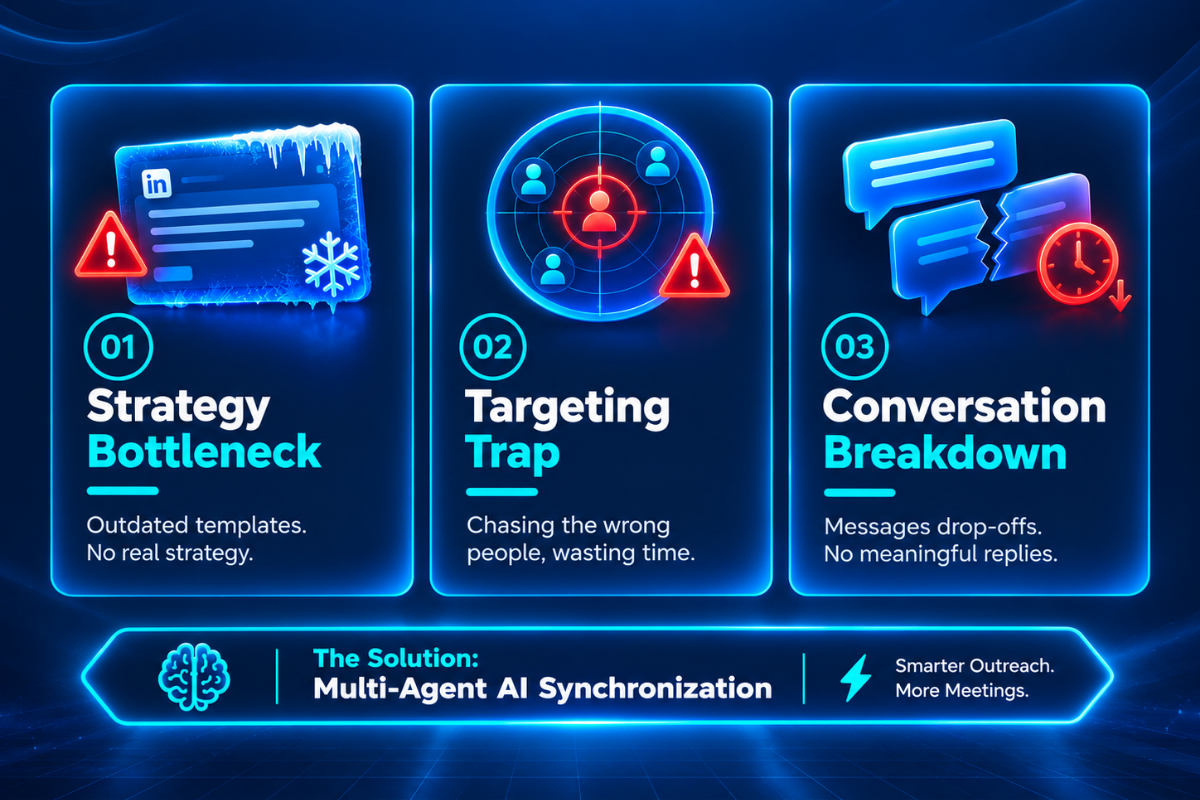
Concept graphic explaining why outbound marketing fails for many AI companies.

By the time companies conclude outbound doesn’t work, they’ve usually experienced activity without a qualified pipeline, messaging attracting the wrong buyers, inconsistent deal flow, founder dependency, and tools without structure.
The conclusion feels logical. But the diagnosis is wrong.
Outbound didn’t fail. The system was never engineered.

What Actually Works

Companies that eventually build predictable pipelines don’t start by sending more messages. They start by slowing down.
They define:
  • who should not be targeted
  • what qualifies as a real opportunity
  • what pipeline targets actually look like
  • how outbound connects to revenue, not marketing
Outbound becomes infrastructure, not experimentation. Once this foundation exists, activity finally compounds instead of resetting every quarter.

Before Scaling Outbound, Start With Diagnosis

Most AI founders don’t need another outreach tactic. They need clarity on whether predictable outbound is even viable for their current positioning, ICP, and sales motion.
That’s why every engagement we run begins with a Pipeline Diagnostic™.
It’s a structured review designed to answer a simple question: Can your pipeline become predictable and what must change if it can?
The diagnostic evaluates ICP clarity and exclusions, qualification standards, pipeline breakdown points, outbound readiness, and realistic pipeline math.Sometimes the answer is “build now.” Sometimes it’s “fix fundamentals first.”
Either way, founders leave with clarity instead of assumptions.

The Real Shift

The companies that grow consistently stop asking:
“How do we get more leads?”
They start asking:
“How do we build a system that produces qualified opportunities predictably?”
That shift changes everything like the hiring decisions, forecasting confidence, and the founder’s role inside sales.Outbound stops feeling like a gamble. It becomes infrastructure.

The Next Step

If your delivery is strong but pipeline still feels inconsistent, the smartest move isn’t scaling activity - it’s understanding why predictability breaks down.
You’ll learn whether predictable outbound is viable for your business and what needs to change before scaling.
If it’s a fit, you’ll know the path forward.If it’s not, you’ll know exactly why.
Either way, you stop guessing.