LinkedIn Outreach

The 3 Silent Killers of LinkedIn Lead Generation in 2026

HT

Hajana Technologies

October 19, 2026
8 min read
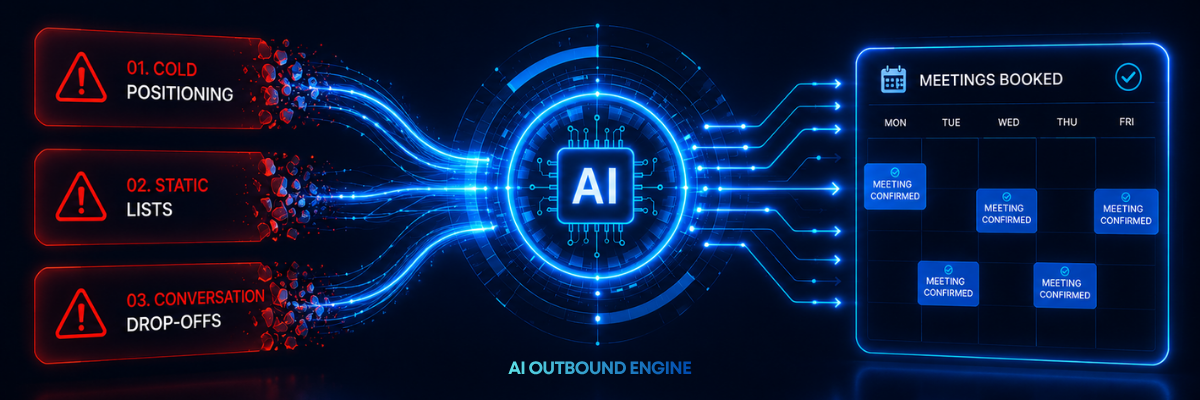
Banner depicting three red warning panels for Cold Positioning, Static Lists, and Conversation Drop-offs passing through an AI Outbound Engine into a calendar filled with confirmed meetings
Generating qualified leads on LinkedIn should be straightforward: identify decision-makers, start meaningful conversations, and convert high-intent relationships into booked meetings.
Yet, for modern growth leaders, founders, and sales teams, scaling outbound pipeline often feels like an uphill battle. Despite putting in dozens of hours every week, response rates hover in single digits, connection requests go ignored, and calendar slots remain unfilled.
Why is LinkedIn outreach harder than ever in 2026?
The reality is that traditional outreach tactics - like copy-pasting message templates, setting static filter lists, and running manual follow-up cadences - no longer work. Modern decision-makers spot generic automation instantly and ignore cold blasts.
If your team is struggling to fill its pipeline, you are likely falling victim to the 3 silent killers of LinkedIn lead generation.


1. The Strategy Bottleneck: Cold Positioning & Template Fatigue

The Problem: Most outreach campaigns fail long before the first message is sent. Crafting contextual, high-converting positioning requires deep market research, signal analysis, and audience segmentation.
Because conducting thorough research on every target segment takes hours of manual work, teams resort to generic templates.
The Result: Your inbox messages sound identical to hundreds of other sales reps. Without real-time market signals and tailored positioning, decision-makers tune out your value proposition instantly.

2. The Targeting Trap: Relying on Static Lists and Low-Intent Audiences

The Problem: Relying on basic demographic filters (like job title or industry) produces broad, bloated prospect lists filled with contacts who have zero buying intent.
Finding true decision-makers who actually experience the pain point you solve requires constant list refining, account cross-referencing, and continuous auditing. For insights into how leading B2B organizations refine targeting and hyper-personalize engagement, explore McKinsey & Company’s B2B Commercial Growth Insights.
The Result: Wasted connection requests, low engagement rates, and risky account activity spikes - all while spending valuable time pitching prospects who were never a fit to begin with.

3. The Conversation Breakdown: Lost Leads and Dragging Follow-Ups

The Problem: Securing a connection or initial reply is only the first hurdle. The real challenge lies in managing multi-touch conversation threads, answering objections dynamically, maintaining tone of voice, and guiding the prospect toward a calendar link.
When team members manage dozens of active dialog threads manually across scattered tools, follow-ups drop off, contextual nuance gets lost, and response times drag-creating the feeling that LinkedIn outbound is a full-time job.
The Result: Prospects lose interest during slow back-and-forth exchanges, and high-intent opportunities slip through the cracks before a meeting is ever booked.

The Shift: Moving from Manual Fatigue to Coordinated AI Systems

The solution to these challenges isn't working longer hours or sending higher message volumes - it's eliminating manual friction through intelligent system coordination.
Doing lead generation manually at scale is unsustainable, but relying on old-school, static message automation damages your brand reputation. Modern outreach demands contextual intelligence, precision targeting, and autonomous dialogue management. For a deeper technical perspective on how modern communication and protocol standards enable synchronized agent workflows, review the Model Context Protocol Specification.
Imagine an outbound workflow where:
  • Strategy is handled by intelligence that self-trains on your brand positioning and market signals.
  • Targeting is continuously refined to surface high-fit, intent-driven prospects with tailored messaging per segment.
  • Replies are managed in your natural brand voice, handling objections dynamically and placing pre-booked meetings directly on your calendar.

Something Game-Changing Is Arriving from Hajana Technologies

At Hajana Technologies, we believe you shouldn't have to choose between personalized, intent-driven outreach and complete operational efficiency.
We are developing an autonomous multi-agent AI engine built to tackle all three silent killers at once - synchronizing strategy, precision targeting, and response management into a single, seamless flywheel.
  • Zero manual heavy lifting.
  • No generic blast templates.
  • Just high-intent relationships and pre-booked meetings delivered directly to you.
Stay tuned - the future of LinkedIn outreach is landing soon at Hajana Technologies.
Want early access? Contact us today at Hajana Technologies Contact to connect with our team!

Related Resources

Continue exploring our insights and case studies

Salesforce Health Score
Calculator

Salesforce Health Score

Discover how well your Salesforce is performing across data, automation, and reporting with our free assessment tool.

Try Calculator
Automation Savings Calculator
Calculator

Automation Savings Calculator

Discover the hidden cost of manual work and calculate how much you could save with AI automation.

Try Calculator
AI ROI Calculator
Calculator

AI ROI Calculator

Calculate how much money you're wasting on manual work and your potential savings with AI implementation.

Try Calculator
3 Silent Killers of LinkedIn Lead Generation in 2026 | Hajana Technologies