LinkedIn Outreach

Preparing Your Infrastructure for the Next Paradigm: Building a Quantum-Ready Architecture Today

HT

Hajana Technologies

October 29, 2026
8 min read
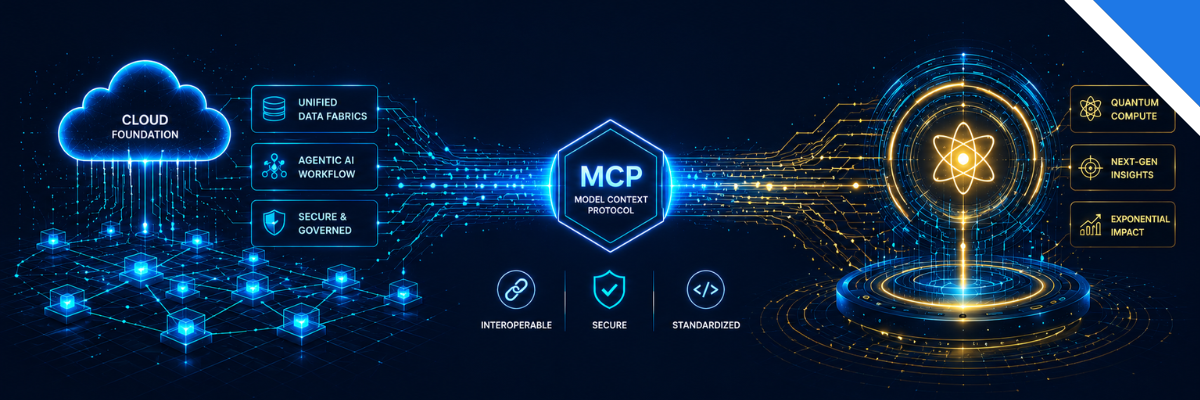
Panoramic technology diagram showing a cloud foundation, unified data fabrics, agentic AI workflows, and secure governance connected through the Model Context Protocol (MCP) to a quantum computing core, highlighting interoperability, security, standardization, and next-generation insights.
The enterprise technology timeline is accelerating at a rate that traditional IT planning was never designed to handle. Leaders are actively managing the shift toward autonomous AI, optimizing hybrid cloud overhead, and wrestling with massive data silos. Amid these immediate operational demands, a new horizon is approaching: Quantum Computing.
While practical quantum supremacy across global business workflows remains a emerging frontier, the strategic window to prepare for it is already open.
Many technology executives view quantum integration as a distant, futuristic upgrade - a module to be plugged into corporate infrastructure once the hardware matures. However, you cannot plug quantum algorithms into unstructured, fragmented legacy data.
The foundational engineering work required today - structuring clean data fabrics, implementing robust Model Context Protocol (MCP) standards, and orchestrating Agentic AI workflows - is the exact prerequisite for integrating quantum acceleration tomorrow.


The Prerequisites for Quantum Integration

Quantum computing excels at solving multi-variable optimization, complex logistical simulations, and real-time probabilistic calculations that completely stall classical silicon architectures. However, quantum algorithms require highly structured, deterministic inputs to execute.
If your enterprise relies on fragmented databases, uncalibrated operational telemetry, and legacy batch processing, quantum computing will only accelerate your existing noise.
To build a quantum-ready architecture today, leaders must focus on three foundational pillars:

1. Unified Data Fabrics Over Legacy Silos

Quantum algorithms process high-dimensional state spaces simultaneously. To feed these models, your data layer must provide zero-friction accessibility and strict data provenance. Transitioning from isolated transactional databases to clean, real-time data streams ensures that when quantum processors are deployed, your pipeline can instantly feed them structured telemetry.

2. Open Protocol Standards & Real-Time Orchestration

Integrating futuristic computational layers alongside legacy record-keeping systems requires standardization. By implementing open interaction frameworks - such as the Model Context Protocol (MCP) - enterprises establish secure, auditable pipelines that allow classical systems, autonomous AI agents, and emerging quantum co-processors to exchange state information without friction.

3. Agentic AI as the Operational Orchestrator

Before quantum hardware takes on high-stakes business calculations, autonomous AI agents must first manage the orchestration layer. Agentic systems handle intent recognition, data pre-processing, and multi-step task routing. Building an agentic workflow core today establishes the intelligent middleware needed to govern hybrid classical-quantum executions in the future. For a deep dive into why agentic architectures are replacing legacy software cores, read our analysis on The Death of Static CRM/ERP: Why Agentic AI is the New Enterprise Core.

The Continuous Evolution: Cloud to AI to Quantum

The transition from cloud computing to enterprise AI, and eventually to quantum computing, is not a series of disconnected, reactionary technology upgrades. It is a single, continuous evolution toward ultimate operational speed and business intelligence.
  • The Cloud Era solved the problem of scale, elasticity, and centralized storage.
  • The AI Era introduced cognitive reasoning, dynamic contextual understanding, and autonomous execution.
  • The Quantum Era will solve exponential complexity, combinatorial optimization, and instantaneous system modeling.
Organizations that failed to modernize their cloud infrastructure struggled to deploy basic LLMs effectively. Similarly, organizations that delay building synchronized AI engines and structured data fabrics will find themselves completely locked out of the performance advantages of quantum computing.

Bridge the Technology Gap with Hajana Technologies

Preparing for future computational shifts requires deep systems discipline, modern interface standards, and architectural foresight. At Hajana Technologies, we help enterprise organizations design and implement production-grade AI frameworks, multi-agent orchestration engines, and unified data architectures that solve today's operational challenges while remaining adaptable for tomorrow's technology paradigms.
Whether you are streamlining outbound growth or modernizing your core enterprise software, our team helps technology leaders build scalable, future-proof infrastructures. To explore how we can strengthen your enterprise architecture roadmap, discover our insights on why LinkedIn outbound feels like a full-time job or reach out directly via Hajana Technologies Contact.

Conclusion

The quantum future will not be defined by who buys the hardware first - it will be defined by who is architecturally prepared to feed it.
Leaders who structure their enterprise data layers, protocol boundaries, and agentic systems correctly today will be the ones positioned to dominate tomorrow's quantum-powered landscape. Connect with our engineering team at Hajana Technologies to start building your future-ready enterprise architecture.

Related Resources

Continue exploring our insights and case studies

Salesforce Health Score
Calculator

Salesforce Health Score

Discover how well your Salesforce is performing across data, automation, and reporting with our free assessment tool.

Try Calculator
Automation Savings Calculator
Calculator

Automation Savings Calculator

Discover the hidden cost of manual work and calculate how much you could save with AI automation.

Try Calculator
AI ROI Calculator
Calculator

AI ROI Calculator

Calculate how much money you're wasting on manual work and your potential savings with AI implementation.

Try Calculator
Building a Quantum-Ready Enterprise Architecture Today | Hajana Technologies