Lean Six Sigma

Why 70% of Enterprise AI Implementations Fail (And How Lean Six Sigma Fixes It)

HT

Hajana Technologies

November 3, 2026
8 min read
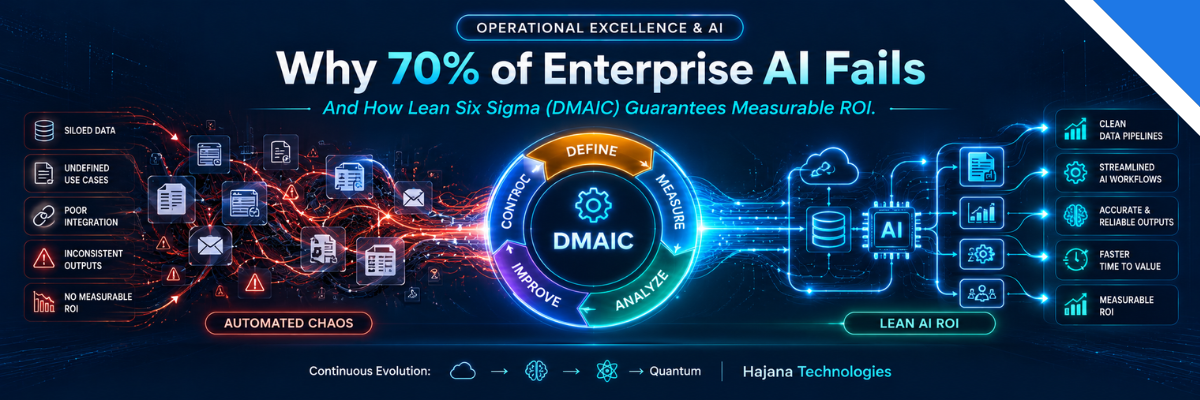
Banner titled 'Why 70% of Enterprise AI Fails' illustrates the transformation of chaotic siloed data through a central DMAIC framework into clean data pipelines and measurable AI ROI.
Enterprise leadership is currently caught in a high-stakes AI gold rush. Executive boards are mandating rapid artificial intelligence adoption, while IT departments hurry to deploy generative models, automated routing scripts, and multi-agent systems across corporate CRMs and ERPs.
Yet, despite billions invested globally, industry benchmarks show a stark reality: nearly 70% of enterprise AI projects fail to deliver their projected return on investment.
Why are so many high-budget AI initiatives faltering?
The problem is rarely the underlying technology, the model size, or the vector database choice. The failure lies in a fundamental operational mistake: layering advanced AI onto broken, unmeasured, and wasteful workflows.
If you automate a chaotic process, you do not get an intelligent enterprise - you simply get automated chaos at scale. To achieve deterministic ROI, forward-thinking operations leaders are turning to a proven operational framework: Lean Six Sigma (DMAIC).


The Root Cause: Automating Operational Waste

In classical Lean manufacturing, waste (Muda) includes unnecessary steps, waiting times, defects, and over-processing. In modern digital enterprise operations - such as B2B sales pipelines, customer service routing, or revenue forecasting - digital waste is equally prevalent.
When organizations deploy LLMs or automated agents directly onto unoptimized CRM workflows without prior process mapping, they encounter three major failure modes:
  1. Amplified Defects: AI models trained on or integrated into bad process data will generate hallucinations, misroute priority leads, and execute incorrect workflow triggers at ten times the speed of human operators.
  2. Contextual Noise: Feeding unstandardized, fragmented customer interactions into Retrieval-Augmented Generation (RAG) frameworks creates low-quality context windows, resulting in poor model accuracy and soaring API overhead costs.
  3. Unmeasurable ROI: Without clear pre-deployment process metrics, enterprise leaders cannot determine whether performance gains stem from the AI integration or simple variance in human activity.

The Fix: Integrating DMAIC Before Writing a Line of Code

To guarantee measurable financial returns, technology and operational leaders must treat AI deployment as a continuous improvement initiative rather than a standard software installation.

By applying the DMAIC (Define, Measure, Analyze, Improve, Control) methodology before selecting models or writing integration code, enterprises ensure that AI directly targets root-cause inefficiencies. As highlighted in established frameworks by the {Lean Six Sigma Institute}(https://leansixsigmainstitute.org/), structuring process inputs and controlling variance prior to technology integration is essential for eliminating operational waste.

THE DMAIC AI DEPLOYMENT FRAMEWORK

DEFINE

Identify process bottlenecks & business-critical KPIs

MEASURE

Establish strict pre-AI operational baselines & cycle times

ANALYZE

Eliminate non-value-added steps & clean telemetry layers

IMPROVE

Deploy specialized Agentic AI to automate standardized tasks

CONTROL

Implement real-time monitoring, MLOps, & protocol standards

1. Define: Pinpoint the Process Bottleneck

Start by mapping the end-to-end process value stream. Are your account executives losing hours to manual prospect research, or are warm leads dropping off during multi-stage follow-up cadences? Clearly define the operational problem statement and target financial impact.

2. Measure: Establish Strict Baseline Metrics

Before building prompt templates or agent pipelines, establish clear baseline data:
  • What is the current process cycle time from lead capture to initial meeting?
  • What is the baseline defect rate (e.g., misrouted tickets, inaccurate data entry)?
  • What is the exact cost per transaction under classical human execution?

3. Analyze: Remove Process Waste and Standardize Data

Clean the workflow before introducing intelligent automation. Eliminate redundant approval layers, standardize form entries, and unify fragmented data sources. As highlighted in modern enterprise systems engineering, connecting AI agents to structured enterprise data requires standardized interfaces - such as the open Model Context Protocol (MCP) - to ensure seamless, zero-trust data flow across your technical stack.

4. Improve: Deploy Targeted Agentic AI Systems

Once the process is streamlined and standardized, deploy specialized autonomous AI agents to execute value-added tasks. Instead of relying on broad, off-the-shelf models that struggle with complex operations, implement specialized domain agents engineered for specific pipeline tasks.
For example, in B2B sales outreach, replacing manual inbox tasks with coordinated strategy and intent-filtering agents can drastically reduce cycle times while boosting engagement. To see how autonomous agent coordination transforms traditional outreach bottlenecks, explore our detailed breakdown on how to stop spending hours on manual LinkedIn outreach.

5. Control: Implement Automated MLOps & Quality Assurance

Sustaining long-term gains requires continuous process monitoring. Implement real-time quality control checks, telemetry monitoring, and human-in-the-loop validation thresholds to prevent model drift and maintain operational precision. For a broader perspective on how agentic intelligence replaces legacy record-keeping software cores, explore our analysis on why agentic AI is becoming the new enterprise core.

Achieve Deterministic AI ROI with Hajana Technologies

Transitioning from speculative AI pilots to predictable, lean operational systems requires both process engineering discipline and modern software architecture. At Hajana Technologies, we combine Lean process mapping with cutting-edge multi-agent AI frameworks to eliminate workflow waste and maximize enterprise ROI.
Our engineering team helps operations and IT executives:
  • Conduct thorough process audits to baseline key performance metrics before software deployment.
  • Design unified, secure data fabrics and MCP integration layers across legacy CRM and ERP platforms.
  • Build custom, domain-specific AI agent architectures that deliver measurable reductions in operational cycle times.
Stop layering expensive AI on top of broken processes. Speak with our systems engineering team at Hajana Technologies or reach out directly via Hajana Technologies Contact to design a lean, ROI-driven AI deployment strategy.

Conclusion

AI is not a magic wand that fixes inefficient operations; it is a multiplier. Multiplying an inefficient process only yields inefficient results at a greater scale.
By grounding your enterprise AI roadmap in Lean Six Sigma principles - measuring first, optimizing second, and automating third - leaders can reliably bridge the gap between AI hype and true bottom-line profitability.

Related Resources

Continue exploring our insights and case studies

Salesforce Health Score
Calculator

Salesforce Health Score

Discover how well your Salesforce is performing across data, automation, and reporting with our free assessment tool.

Try Calculator
Automation Savings Calculator
Calculator

Automation Savings Calculator

Discover the hidden cost of manual work and calculate how much you could save with AI automation.

Try Calculator
AI ROI Calculator
Calculator

AI ROI Calculator

Calculate how much money you're wasting on manual work and your potential savings with AI implementation.

Try Calculator
Why 70% of Enterprise AI Fails (And How Six Sigma Fixes It) | Hajana Technologies