Hajana Technologies Logo
Hajana Technologies
Anthropic Claude

Autonomous Enterprise Agents: Moving from Task Scripting to Goal-Driven Execution

HT

Hajana Technologies

August 21, 2026
10 min read
Autonomous Enterprise Agents: Moving from Task Scripting to Goal-Driven Execution
Traditional automation relies on hardcoded instructions: execute these exact operations, in this sequence, every time. Goal-driven agentic automation flips this paradigm. Instead of handing an LLM a fixed script, you assign it a verified objective and allow it to chart its own execution path.
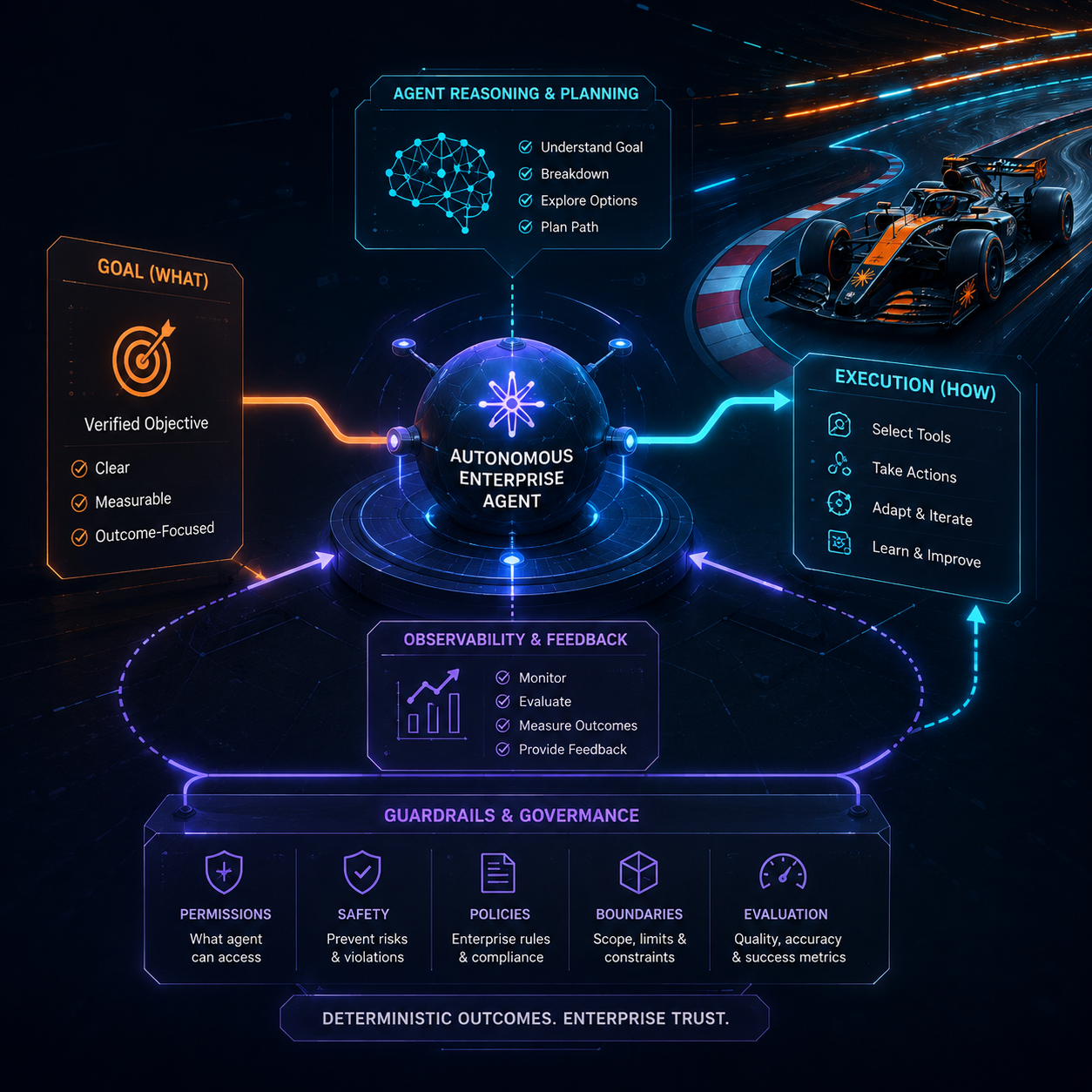
Assigning goals to autonomous agents unlocks immense enterprise leverage, but it also introduces operational risk. An agent empowered to determine its own trajectory is only as reliable as the guardrails, execution boundaries, and evaluation metrics you establish.
This deep dive serves as the capstone for building production-grade AI systems. Building on our foundational work in Designing Claude Skills for Enterprise Scale, we address the central challenge of agentic autonomy: How do you delegate open-ended objectives to an AI agent while guaranteeing deterministic, enterprise-grade outcomes?

Task Automation vs. Goal Automation

In modern software engineering, agentic systems fall into two distinct operational paradigms:

TASK AUTOMATION (Workflows)

  • 1Deterministic execution paths, Predefined tool calls, Hardcoded step sequencing
  • 2Best for: High-predictability, repetitive, low-variance administrative tasks
VS

GOAL AUTOMATION (Autonomous Agents)

  • 1Dynamic reasoning loops, Real-time tool selection, Self-correcting execution
  • 2Best for: Open-ended troubleshooting, complex refactoring, multi-step analysis
Neither model is inherently superior; they address fundamentally different problem spaces. Deploying a complex autonomous agent to execute a simple, predictable workflow inflates API costs and introduces unnecessary latency.
Goal-driven automation earns its operational footprint when execution paths cannot be known in advance. Use deterministic scripts when a task is predictable. Reach for an autonomous agent when four key criteria are met:
  1. Open Execution Paths: The steps required to reach the outcome vary based on dynamic environment feedback.
  2. Action Capability: The agent must interact with live tools, execute code, or query infrastructure.
  3. Measurable Outcome: Success can be objectively verified through ground-truth signals (e.g., passing unit tests or clean schema validations).
  4. Governed Oversight: A human operator can review execution traces and intercept critical state changes.

The 4-Stage Autonomy Spectrum

Autonomy should never be implemented as a binary toggle. Instead, treat autonomy as a configurable dial, escalating authority only as safety bounds and execution reliability are proven.
Autonomy LevelAgent AuthorityHuman InvolvementPrimary Operational Use Case

Level 1: Adviser

Synthesizes context & recommends actions

Reviews every output; executes actions manually

High-risk architectural changes, legal analysis

Level 2: Assistant

Drafts execution plans & stages payloads

Approves or rejects proposed tool calls before execution

CI/CD pipeline modifications, production config updates

Level 3: Operator

Executes actions autonomously within bounded sandbox

Reviews output traces asynchronously post-execution

Automated bug fixing, local refactoring, log analysis

Level 4: Autonomous

Full execution loop across turns with automated checks

Intervenes only on systemic exceptions or boundary failures

Scheduled routine maintenance, automated dependency updates

Key Architectural Insight: Modifying the autonomy level does not require altering the underlying foundation model. It requires adjusting the authorization boundaries enforced by your runtime harness.

Selecting Your First High-Value Objective

Selecting an overly complex or ungrounded initial goal is the fastest way to compromise organizational trust in AI automation. Screen potential candidate tasks using two diagnostic vectors:

HIGH RISK / HARD TO VERIFY

Keep Human-Led (e.g., Brand Strategy)

LOW RISK / HARD TO VERIFY

Level 1-2 Autonomy (e.g., Code Documentation)

HIGH RISK / EASY TO VERIFY

Level 2-3 Autonomy (e.g., Database Migrations)

LOW RISK / EASY TO VERIFY

Level 4 Autonomy (e.g., Unit Test Generation)

  1. Blast Radius & Reversibility: What is the business impact of a false positive, and how easily can state changes be rolled back? Tasks with isolated, sandboxed blast radiuses (e.g., git feature branches) are primary targets for aggressive automation.
  2. Verification Signal Clarity: Can the result be evaluated deterministically? Software engineering became the leading adoptor of agentic workflows because compilers, linters, and automated test suites supply unequivocal verification signals.

The 5 Pillars of a Delegable Goal

Blog image
For an autonomous agent to execute an objective safely, the goal specification must contain five structural elements:
  1. Target Objective: A crisp, unambiguous definition of the desired end state.
  2. Deterministic Verification Signal: An objective check (e.g., exit code 0, clean build, passing schema) confirming goal achievement.
  3. Bounded Tool & Scope Permissions: Explicit whitelist of tools, file paths, and external endpoints the agent may access.
  4. Hard Stopping Conditions: Turn limits, context window caps, and budget ceilings to prevent infinite loops.
  5. Human Approval Thresholds: Pre-defined triggers requiring explicit human sign-off before committing high-risk actions.

Multi-Layered Verification: The Core Safety Mechanism

The definitive factor separating trustworthy agents from brittle ones is their capacity to receive ground-truth feedback from their environment. An agent navigating without objective feedback will confidently drift off-target.

To establish enterprise reliability, construct verification using a three-tier evaluation stack:

Compilers, linters, unit tests, and CLI validators

TIER 1: GROUND-TRUTH CHECKS

If Ground-Truth Checks Pass
Secondary model judges output against explicit schemas

TIER 2: LLM EVALUATOR

If Automated Evaluator Passes
Final gatekeeper for subjective quality & policy checks

TIER 3: HUMAN CHECKPOINT

Native Goal Orchestration via the /goal Command

When building within environment toolchains like Claude Code, goal-driven execution is natively supported via dedicated commands. Executing /goal initializes an autonomous loop that persists across multiple reasoning turns until the specified condition evaluates to true:
Bash
/goal all unit tests in tests/billing/ pass cleanly and lint step exits 0, or stop after 15 turns

The Dual-Model Evaluation Loop

Under the hood, goal execution relies on an isolated evaluation loop to maintain objectivity:
Defines Objective & Stop Criteria via /goal

USER

Executes code edits, runs shell commands, reads logs

PRIMARY AGENT

Scans transcript against ground-truth outputs

EVALUATOR MODEL

Passes failure context to Primary Agent for next turn

Condition NOT Met

Terminates session and returns control to operator

Condition MET

Unifying the Enterprise Agent Architecture

Achieving safe, goal-driven autonomy requires stacking four distinct operational layers into a cohesive system:

ORCHESTRATION

Goal Definition, Verification Signals, & Stop Conditions

RUNTIME

Agent Harness, Context Window Management, & Memory Buffers

METHOD LAYER

Modular Claude Skills Codifying Standardized Execution Rules

INFRASTRUCTURE

Model Context Protocol (MCP) Connectors & Execution SDKs

  • Method Layer: Codified through Claude Skills, defining how specific technical tasks must be performed.
  • Infrastructure Layer: Connected via the Model Context Protocol (MCP), providing secure access to enterprise APIs and live databases.
  • Runtime Layer: Managed by the agent harness, handling state persistence and tool execution safety.
  • Orchestration Layer: Governed by goal-driven evaluation loops, ensuring output alignment.

Enterprise Governance: The 3-Tier Human-AI Control Model

To maintain operational compliance, enterprise teams must establish explicit decision-ownership boundaries before deploying autonomous agents into production environments:

Scope: Reversible, sandboxed, fully verifiable operations.

TIER 1: AGENT-AUTONOMOUS (Execute & Log)

Scope: High-visibility or state-modifying operations requiring pre-execution signoff

TIER 2: HUMAN-APPROVED (Stage & Gate)

Scope: Strategic, policy-heavy, or non-verifiable decisions.

TIER 3: HUMAN-OWNED (Advise Only)

5 Systemic Agent Failure Modes

When reviewing autonomous agent implementations, our engineering team regularly identifies five structural failure patterns:
  1. Ungrounded Goal Specifications: Assigning abstract directives (e.g., "Optimize the codebase") without supplying objective ground-truth verification checks.
  2. Premature Autonomy Escalation: Granting Level 4 execution permissions before verifying the agent's accuracy at Levels 2 and 3.
  3. Misplaced Authorization Gates: Requiring human approval for low-risk, reversible operations while leaving high-impact tool calls un-gated.
  4. Prompt-Based Safety Guardrails: Relying on plain-text system prompts to restrict behavior rather than enforcing hard permission boundaries inside the runtime harness.
  5. Uncapped Loop Execution: Failing to set strict token budgets or turn caps, allowing confused agents to execute indefinitely.

Accelerate Your Enterprise AI Strategy with Hajana Technologies

Transitioning from simple prompt engineering to safe, goal-driven agentic systems requires advanced runtime architecture, rigorous governance, and battle-tested verification frameworks.
As a leading enterprise AI development company, Hajana Technologies deploys forward-deployed engineers to partner with your technical leadership to design, build, and deploy production-grade AI agents tailored to your infrastructure.

How We Help

  • Agentic Architecture Design: Structure modular agent loops with deterministic verification layers and context-optimized skill sets.
  • Custom MCP Integration: Connect Anthropic Claude agents safely to enterprise databases, internal microservices, and CI/CD pipelines.
  • Enterprise Governance & Security: Implement strict multi-tiered permission boundaries, audit logging, and human-in-the-loop controls.
Discover how we help engineering organizations scale autonomous systems through our AI Consulting & Automation Services, or explore our Claude Lead Qualification Agent Case Study to see our production architectures in action.

Related Resources

Continue exploring our insights and case studies

Salesforce Health Score
Calculator

Salesforce Health Score

Discover how well your Salesforce is performing across data, automation, and reporting with our free assessment tool.

Try Calculator
Automation Savings Calculator
Calculator

Automation Savings Calculator

Discover the hidden cost of manual work and calculate how much you could save with AI automation.

Try Calculator
AI ROI Calculator
Calculator

AI ROI Calculator

Calculate how much money you're wasting on manual work and your potential savings with AI implementation.

Try Calculator
Autonomous Enterprise Agents: Goal Automation Architecture | Hajana Technologies